On 22nd September, Focus on Safety wrote to seven political parties asking for their commitment, by 27th October, to begin implementing our seven proposed reforms should they be part of the Government after the election, or support implementation if they are not in Government. Below are the parties’ responses to each of our seven reforms in a scorecard, with the parties listed in the order that their responses were received.
For a full explanation of each of the seven reforms go to: Problems & Solutions | Proposed Reforms | Focus on Safety
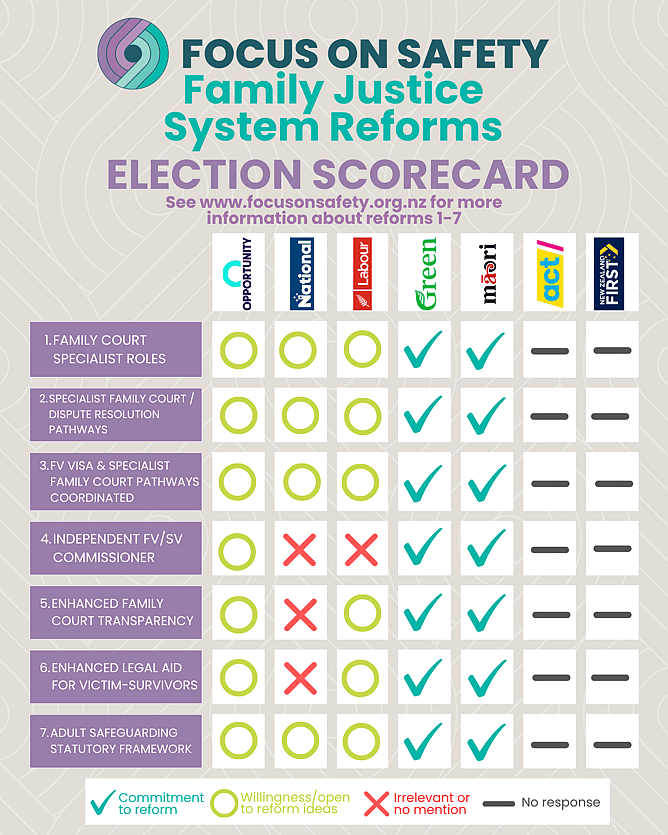
Below are the parties’ written responses to each of our seven reforms. Portions of responses are omitted that are not directly relevant to the proposed reforms.
Responses from: Opportunity Party, National Party, Labour Party, Green Party, Te Pāti Māori
No Response from: ACT, NZ First
Focus on Safety seven proposed reforms & political party responses:
1. Introducing new FV, SV specialist roles to provide fuller and better information to inform court decisions and provide a safe voice for children and adults at risk to participate in decisions about them.
AND
2. Developing a family violence/ sexual violence (FV/SV) Specialist Family Court and Family Dispute Resolution pathway that introduces policies and processes, including accredited/trained Judges, who hear from FV, SV expert report writers and FV, SV child and adult at risk communication specialists that enable the court to identify and safely respond to FV, SV, neglect and exploitation.
[Opportunity] “In relation to broader Family Court reform, we recognise the importance of dedicated specialist pathways.”
[National] “Victims and children must also be safe when they interact with the Family Court and other government systems. National shares the fundamental objective behind the Focus on Safety proposals: children and adults experiencing family and sexual violence must be safer, victims must be heard, and the justice system must not compound the harm they have already experienced. We recognise the importance of having people across the system who understand family and sexual violence and can recognise and respond appropriately to risk. We also recognise the importance of better information sharing and coordination where somebody is at serious risk.”
[Labour] “When in Government, Labour is open to asking for advice on specialist roles to inform court decisions. Labour is open to asking for advice on Specialist Family Court and Family Dispute Resolution pathway in Government.”
[Greens] “Yes, the Green Party supports introducing new family violence and sexual violence specialist roles to inform court decisions and enable children and adults at risk to participate safely. This is consistent with our commitment to ensuring the family justice system upholds Te Tiriti o Waitangi and effectively responds to family violence.
“Yes, the Green Party supports the development of a specialist Family Court and Family Dispute Resolution pathway for family violence and sexual violence cases that prioritises the safety of victim-survivors and children and recognises the impacts of trauma. We acknowledge that there is already well-established research and policy work that outlines the specific reforms needed for safe responses and Greens will be guided by that work. We would therefore support a specialist pathway that uses accredited judges, specialist report writers and applies trauma-informed, culturally safe and child-centred processes. It should provide clear referral pathways to iwi and community providers, expanded access to specialist advocates, counselling and healing support, and stronger support for tamariki, rangatahi and whānau. In the immediate term to reduce delays, we would expand Te Ao Mārama approaches, better resource community law centres, increase court funding, judges and staff, and reform procedures, fees and barriers to pro bono work.”
[Te Pāti Māori] “Te Pāti Māori is committed to implementing all seven reforms to the Family Court if we are part of the next government.”
3. Coordinating FV Visa Proceedings with the FV/SV Specialist Family Court
[Opportunity] ”We have a willingness to reform in all 7 of these categories. We currently do not have the level of specificity in our policy that you are querying, but of course see the merit in all of your ideas.”
[National] “We acknowledge the importance of victims of family violence having support to leave their abusive situations, including access to appropriate visas where needed. National intends to review the Victims of Family Violence work and resident visas in the next term including consultation with the relevant sectors to seek expert input.”
[Labour] “Labour is open to asking for advice on coordinating FV Visa Proceedings with the FV/SV Specialist Family Court in Government. We are committed to a system that supports victim-survivors and puts an end to violence.”
[Greens] “Yes, the Green Party supports better coordination between family violence visa proceedings and a specialist Family Court pathway. Immigration status should never be used as a tool of coercion, nor create barriers to seeking safety, protection or justice. The Green Party want to see a system that can recognise the ways migration status, language barriers and social isolation can increase vulnerability to family violence and ensure that victim-survivors can access protection without fear of immigration consequences. Coordination should provide a safe, joined-up pathway between immigration and specialist family justice processes so that visa status does not become a barrier to safety or support.”
[Te Pāti Māori] “Te Pāti Māori is committed to implementing all seven reforms to the Family Court if we are part of the next government.”
4. Establishing an Independent FV/SV Prevention & Response Commissioner for oversight and monitoring of family justice responses to, and decisions about, victim-survivors
[Opportunity] “In relation to broader Family Court reform, we recognise the importance of .. independent oversight mechanisms.”
[National] – No response
[Labour] “Family violence is our national shame. While there have been encouraging signs of increased reporting and more prosecutions, there is still so much more work to do. We are open to seeking further advice on how this can be achieved in Government. We are committed to delivering a child harm prevention and response action plan through Te Aorerekura.”
[Greens] “Yes, the Green Party would support establishing an independent Family Violence and Sexual Violence Prevention and Response Commissioner. There is a need for a role that can provide independent oversight of family justice responses, monitor whether victim-survivors and children are safer after interventions, and report publicly on access, equity, timeliness, misidentification, charging, outcomes and reoffending. The Greens would want to see a Commissioner that engages with victim-survivors, whānau, iwi, kaupapa Māori providers and specialist sectors to evaluate whether agencies are meeting trauma-informed and culturally safe standards.”
[Te Pāti Māori] “Te Pāti Māori is committed to implementing all seven reforms to the Family Court if we are part of the next government.”
5. Enabling access to all Family Court data and processes for designated FV and SV specialist researchers and accredited media (with strict controls to protect privacy of court participants) to ensure a transparent Family Court
[Opportunity] “In relation to broader Family Court reform, we recognise the importance of [...] improving researcher access to data to ensure transparency and continuous improvement.”
[National] – No response
[Labour] “Labour is open to consulting on this proposal in Government. Labour believes the handling of people’s information should be done so in a way that protect people's rights and privacy, and also believes that there should be transparency where possible in legal processes.”
[Greens] “Yes, the Green Party supports carefully controlled access to Family Court data and processes for designated specialist researchers and accredited media, with strict protections for participants’ privacy and safety. Our policy supports transparency and accountability across the justice system, and we would therefore support the publication of advice to judges on family violence, sexual violence and Family Court matters where appropriate. The Green Party supports greater transparency and accountability within the Family Court, provided the safety of victim-survivors and other participants are adequately provided for. Controlled access for approved researchers and accredited media should only occur where robust privacy protections and independent oversight are in place. Reporting should support public accountability while helping identify disparities in outcomes and barriers to justice experienced by different communities. Transparent advice and guidance should also improve public understanding and enable evidence-informed scrutiny without exposing victim-survivors or children.”
[Te Pāti Māori] “Te Pāti Māori is committed to implementing all seven reforms to the Family Court if we are part of the next government.”
6. Ensuring victim-survivor access to non-means-tested, non-recoverable legal aid
[Opportunity] “We also acknowledge the ongoing discussions regarding non-means tested legal aid for protection order proceedings…We have a willingness to reform in all 7 of these categories. We currently do not have the level of specificity in our policy that you are querying, but of course see the merit in all of your ideas.”
[National] – No response
[Labour] “Labour will review the legal-aid system and its effectiveness in Government in a cost effective way drawing on existing information and expertise. We will also separately look at how victims and survivors are treated through the justice process, with view to better supporting victims and survivors. Labour believes that lack of financial means should not be a barrier to access to justice, and every New Zealander should have access to justice.”
[Greens] “Yes, the Green Party supports access to non-means-tested, non-recoverable legal aid for victim-survivors because access to justice should not depend on a person's financial circumstances. This is consistent with our policy to expand legal aid eligibility to cover all people who need it, increase funding for legal assistance, and remove financial barriers to accessing justice. We would also better resource community law centres, reduce or abolish court fees, remove barriers to pro bono work, and reduce the cost of litigation and legal services. Legal support should connect victim-survivors with independent specialist advocacy, with specialist support for tamariki, rangatahi and whānau.”
[Te Pāti Māori] “Te Pāti Māori is committed to implementing all seven reforms to the Family Court if we are part of the next government.”
7. Creating an Adult Safeguarding Statutory Framework with statutory powers to identify, protect, and support adults at risk, mirroring the legislative protections available to children.
[Opportunity] “We also acknowledge the ongoing discussions regarding the potential for an Adult Safeguarding Statutory Framework to better protect vulnerable individuals.”
[National] “There is relevant work underway in relation to safeguarding disabled people as well. The Te Aorerekura Action Plan Update 2026/27 identifies the Centre for Family Violence and Sexual Violence Prevention's leadership of New Zealand Disability Strategy Justice Action 6, relating to safeguarding disabled people and workforce capability, with safeguarding approaches and disability outcomes to be addressed through implementation.”
[Labour] “Labour is open to asking for advice on [how] to better support vulnerable or at risk adults when they engage with the justice system. Safeguarding and supporting vulnerable adults is essential.”
[Greens] “Yes, the Green Party would support exploring the development of an Adult Safeguarding Statutory Framework to identify, protect and support adults at risk of abuse, neglect, exploitation and coercive control. We support developing a statutory adult safeguarding framework that enables early identification, coordinated intervention and practical protection for adults at risk, while respecting autonomy and avoiding further harm. It should be supported by accessible and inclusive services and recognise that effective safeguarding requires early intervention, coordinated responses and sufficient investment in prevention and community-based support.”
[Te Pāti Māori] “Te Pāti Māori is committed to implementing all seven reforms to the Family Court if we are part of the next government.”
Full Political Party Responses to Focus on Safety Reforms
The Opportunity Party Response
We have a willingness to reform in all 7 of these categories. We currently do not have the level of specificity in our policy that you are querying, but of course see the merit in all of your ideas.
The Opportunity Party remains deeply committed to improving the justice system's response to violence and protecting victim-survivors. The Opportunity Party will work across parties to provide a collaborative and lasting solution regarding these issues.
In relation to broader Family Court reform, we recognise the importance of dedicated specialist pathways, independent oversight mechanisms and improving researcher access to data to ensure transparency and continuous improvement. We also acknowledge the ongoing discussions regarding non-means tested legal aid for protection order proceedings and the potential for an Adult Safeguarding Statutory Framework to better protect vulnerable individuals.
We are interested in working collaboratively and constructively with other political parties to address these concerns Focus on Safety have raised. Should we be in the fortunate position to be in Parliament, we would welcome having these discussions further with you.
The Labour Party Response
Note: Labour’s Justice spokesperson Camilla Belich requested to meet, and met with, Focus on Safety representatives before this written response was received.
1. When in Government, Labour is open to asking for advice on specialist roles to inform court decisions. Labour is open to asking for advice on Specialist Family Court and Family Dispute Resolution pathway in Government.
2. Labour is open to asking for advice on coordinating FV Visa Proceedings with the FV/SV Specialist Family Court in Government. We are committed to a system that supports victim-survivors and puts an end to violence.
3. Labour is open to asking for advice on coordinating FV Visa Proceedings with the FV/SV Specialist Family Court in Government. We are committed to a system that supports victim-survivors and puts an end to violence.
4. Family violence is our national shame. While there have been encouraging signs of increased reporting and more prosecutions, there is still so much more work to do. We are open to seeking further advice on how this can be achieved in Government. We are committed to delivering a child harm prevention and response action plan through Te Aorerekura.
5. Labour is open to consulting on this proposal in Government. Labour believes the handling of people’s information should be done so in a way that protect people's rights and privacy, and also believes that there should be transparency where possible in legal processes.
6. Labour will review the legal-aid system and its effectiveness in Government in a cost effective way drawing on existing information and expertise. We will also separately look at how victims and survivors are treated through the justice process, with view to better supporting victims and survivors. Labour believes that lack of financial means should not be a barrier to access to justice, and every New Zealander should have access to justice.
7. Labour is open to asking for advice on to better support vulnerable or at risk adults when they engage with the justice system. Safeguarding and supporting vulnerable adults is essential.
The National Party Response
National strongly condemns all family and sexual violence. Every New Zealander deserves to feel safe in their home, their relationships and their community.
In government, we have put victims at the centre of our response to violent offending, including sexual violence. We also want to ensure our laws better protect children in the most serious cases.
Victims and children must also be safe when they interact with the Family Court and other government systems.
National shares the fundamental objective behind the Focus on Safety proposals: children and adults experiencing family and sexual violence must be safer, victims must be heard, and the justice system must not compound the harm they have already experienced.
We recognise the importance of having people across the system who understand family and sexual violence and can recognise and respond appropriately to risk. The Government launched the Family Violence Risk and Safety Practice Framework in March 2025, providing clear, nationally consistent guidance to frontline workers to recognise family violence risk earlier and respond safely and appropriately.
We also recognise the importance of better information sharing and coordination where somebody is at serious risk.
There is relevant work underway in relation to safeguarding disabled people as well. The Te Aorerekura Action Plan Update 2026/27 identifies the Centre for Family Violence and Sexual Violence Prevention's leadership of New Zealand Disability Strategy Justice Action 6, relating to safeguarding disabled people and workforce capability, with safeguarding approaches and disability outcomes to be addressed through implementation.
We acknowledge the importance of victims of family violence having support to leave their abusive situations, including access to appropriate visas where needed. National intends to review the Victims of Family Violence work and resident visas in the next term including consultation with the relevant sectors to seek expert input.
The Focus on Safety briefing raises significant proposals for further reform. It’s clear there is much more work to do, and National will continue to listen to victim-survivors, specialist organisations and frontline experts about where the system can be improved.
National commits to continuing to strengthen New Zealand’s response to family and sexual violence.
National would be happy to meet with Focus on Safety to hear more about the concerns you have raised and your proposed reforms. We recognise your work across the sector and with victims and welcome the opportunity to hear more about what further improvements could make the system safer and more responsive for victims and their children.
The Green Party Response
Note: Greens Co-leader Marama Davidson requested to meet, and met with, Focus on Safety representatives before this written response was received.
1. Yes, the Green Party supports introducing new family violence and sexual violence specialist roles to inform court decisions and enable children and adults at risk to participate safely. This is consistent with our commitment to ensuring the family justice system upholds Te Tiriti o Waitangi and effectively responds to family violence.
2. Yes, the Green Party supports the development of a specialist Family Court and Family Dispute Resolution pathway for family violence and sexual violence cases that prioritises the safety of victim-survivors and children and recognises the impacts of trauma. We acknowledge that there is already well-established research and policy work that outlines the specific reforms needed for safe responses and Greens will be guided by that work. We would therefore support a specialist pathway that uses accredited judges, specialist report writers and applies trauma-informed, culturally safe and child-centred processes. It should provide clear referral pathways to iwi and community providers, expanded access to specialist advocates, counselling and healing support, and stronger support for tamariki, rangatahi and whānau. In the immediate term to reduce delays, we would expand Te Ao Mārama approaches, better resource community law centres, increase court funding, judges and staff, and reform procedures, fees and barriers to pro bono work.
3. Yes, the Green Party supports better coordination between family violence visa proceedings and a specialist Family Court pathway. Immigration status should never be used as a tool of coercion, nor create barriers to seeking safety, protection or justice. The Green Party want to see a system that can recognise the ways migration status, language barriers and social isolation can increase vulnerability to family violence and ensure that victim-survivors can access protection without fear of immigration consequences. Coordination should provide a safe, joined-up pathway between immigration and specialist family justice processes so that visa status does not become a barrier to safety or support.
4. Yes, the Green Party would support establishing an independent Family Violence and Sexual Violence Prevention and Response Commissioner. There is a need for a role that can provide independent oversight of family justice responses, monitor whether victim-survivors and children are safer after interventions, and report publicly on access, equity, timeliness, misidentification, charging, outcomes and reoffending. The Greens would want to see a Commissioner that engages with victim-survivors, whānau, iwi, kaupapa Māori providers and specialist sectors to evaluate whether agencies are meeting trauma-informed and culturally safe standards.
5. Yes, the Green Party supports carefully controlled access to Family Court data and processes for designated specialist researchers and accredited media, with strict protections for participants’ privacy and safety. Our policy supports transparency and accountability across the justice system, and we would therefore support the publication of advice to judges on family violence, sexual violence and Family Court matters where appropriate. The Green Party supports greater transparency and accountability within the Family Court, provided the safety of victim-survivors and other participants are adequately provided for. Controlled access for approved researchers and accredited media should only occur where robust privacy protections and independent oversight are in place. Reporting should support public accountability while helping identify disparities in outcomes and barriers to justice experienced by different communities. Transparent advice and guidance should also improve public understanding and enable evidence-informed scrutiny without exposing victim-survivors or children.
6. Yes, the Green Party supports access to non-means-tested, non-recoverable legal aid for victim-survivors because access to justice should not depend on a person's financial circumstances. This is consistent with our policy to expand legal aid eligibility to cover all people who need it, increase funding for legal assistance, and remove financial barriers to accessing justice. We would also better resource community law centres, reduce or abolish court fees, remove barriers to pro bono work, and reduce the cost of litigation and legal services. Legal support should connect victim-survivors with independent specialist advocacy, with specialist support for tamariki, rangatahi and whānau.
7. Yes, the Green Party would support exploring the development of an Adult Safeguarding Statutory Framework to identify, protect and support adults at risk of abuse, neglect, exploitation and coercive control. We support developing a statutory adult safeguarding framework that enables early identification, coordinated intervention and practical protection for adults at risk, while respecting autonomy and avoiding further harm. It should be supported by accessible and inclusive services and recognise that effective safeguarding requires early intervention, coordinated responses and sufficient investment in prevention and community-based support.
Te Pāti Māori Response
Te Pāti Māori is committed to implementing all seven reforms to the Family Court if we are part of the next government.

